Start with the child’s age
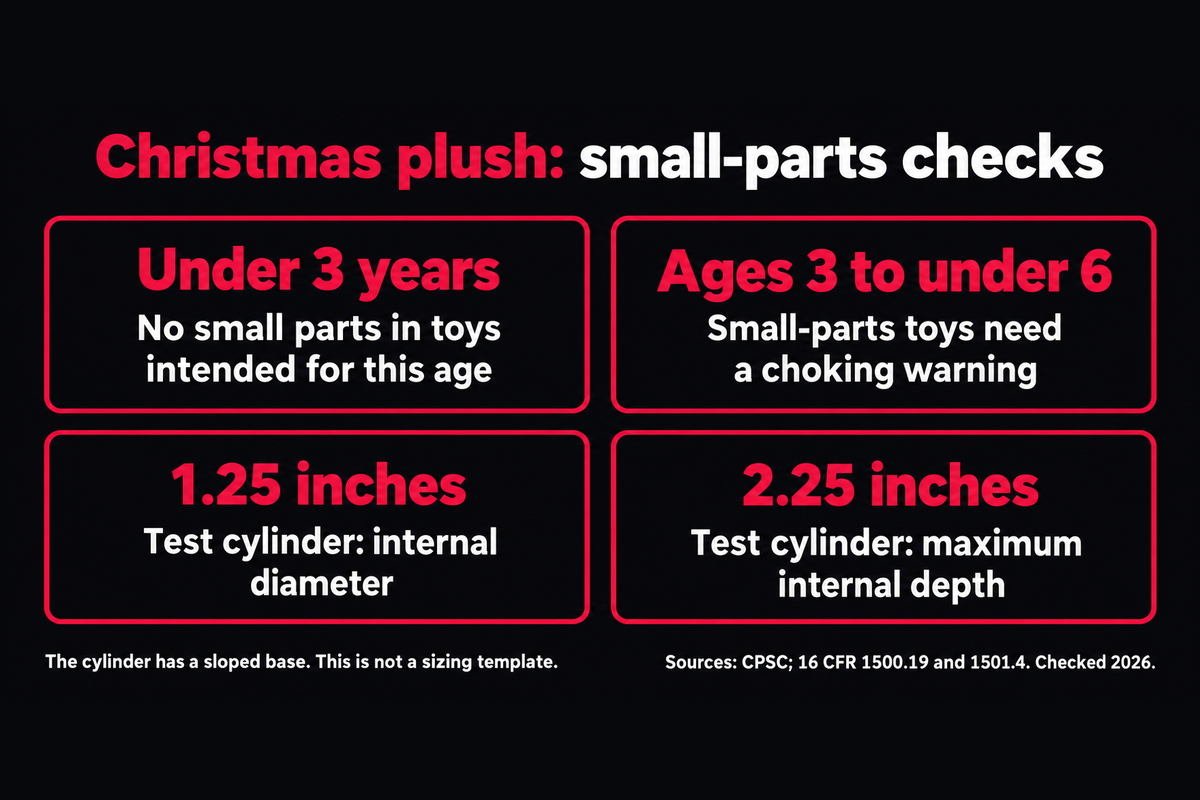
For children under 3, choose toys intended for their age without small parts. The federal small-parts ban covers toys for this group, including parts that detach during prescribed use-and-abuse tests. A warning cannot make an unsuitable toddler toy acceptable.
For ages 3 to under 6, toys containing small parts need the applicable choking warning under 16 CFR 1500.19. The rule concerns the toy’s intended age group. A child’s birthday alone does not determine the labeling requirement.
Read the minimum age before comparing colors or characters. CPSC considers reasonable manufacturer labels, marketing and commonly recognized use when determining intended ages. An older age sticker is not a substitute for a suitable design.
Sources: CPSC Small Parts Ban guidance; 16 CFR 1500.19, checked 2026.
Understand the small-parts cylinder
The small-parts cylinder is a test gauge, not a kitchen measuring cup. Its internal diameter is 1.25 inches. Its sloped base reaches a maximum internal depth of 2.25 inches. A part counts as small if it fits entirely inside in any orientation without compression.
ASTM F963 covers small objects alongside other toy hazards. The federal cylinder procedure appears in 16 CFR 1501.4. A home inspection cannot replace prescribed laboratory tests. Loose fabric, yarn and fuzz released during testing have specific exclusions; this does not make torn seams acceptable.
Sources: CPSC Resellers Guide (2021); 16 CFR 1501.4, checked 2026; ASTM F963-23 (2023).
Check eyes, noses and ribbons
Inspect hard eyes, button noses, bells and other decorations for loose attachments. CPSC warns that removable small eyes and noses can create choking hazards. Embroidered features avoid separate hard pieces, but still check their stitching and the toy’s seams.
Reject a gift with loose components or damaged seams. ASTM F963 includes seam testing for stuffed toys. Keep long ribbons, strings and loops away from infants and very young children. Never hang these toys in a crib or playpen.
Sources: CPSC Think Toy Safety (2012); CPSC Toy Safety guidance, checked 2026.
Check batteries and magnets
A musical plush may hide a battery compartment under its fabric. Read the battery instructions and check the closure. CPSC says toys with button or coin batteries need a secure closure that requires a tool to open. A damaged compartment needs action before further play.
Swallowed button batteries can cause severe burns. Swallowed magnets can attract internally and damage tissue. Keep loose batteries and magnets away from children. Seek immediate medical attention for suspected ingestion. An age label does not remove these hazards.
Sources: CPSC Button Cell and Coin Batteries and Magnets guidance, checked 2026.